Fast Input Optimization: Tricks for Parsing Unsigned Integers
Translated by ChatGPT.
Code repository: github/bench-int-parse.
A small exercise in performance analysis.
This is what OIers/ACMers usually call fast input. This post tests an alternative fast input method that is easy to implement, and the result shows an improvement of around 50%.
Before starting, I make the following constraints on the problem:
- The input is a string like
0 123\n456 123456789, containing only ASCII characters. - The number range is , ignoring the
u64boundary. - In practice there is usually only one separator, but multiple separators should still be handled correctly.
- Tests are run under O2 or O3 optimization levels.
- Based on the input properties, specialize two algorithms:
- Strict: the input contains ASCII characters.
- Non-strict (TODO): only digit characters have values greater than
0x30.
Next I will implement several variants and use the nanobench library for performance testing.
Contestant 1: isdigit
The most common fast input implementations usually use isdigit or an equivalent '0' <= c && c <= '9'.
A typical fast input implementation looks like this:
inline static u64 isd_0_getu(const char *&p) {
  char c = *p++;
  while (!std::isdigit(c))
    c = *p++;
  u64 x = c - '0';
  for (c = *p++; std::isdigit(c); c = *p++)
    x = x * 10 + c - '0';
  return x;
}
For the single-separator case, I also casually wrote an optimized version:
inline static u64 isd_1_getu(const char *&p) {
  while (true) {
    char c = *p++;
    if (std::isdigit(c)) {
      u64 x = c - '0';
      for (c = *p++; std::isdigit(c); c = *p++)
        x = x * 10 + c - '0';
      return x;
    }
  }
}
There are also some “optimizations” floating around, and I tried implementing some of them:
isd-0:isdigit_0_getuaboveisd-1:isdigit_1_getuaboveisd-u8: storecharasu8isd-m10: write multiplication by 10 as(c << 3) + (c << 1)isd-and: writec - '0'asc & 0xfisd-xor: writec - '0'asc ^ '0'isd-range: writeisdigitas'0' <= c && c <= '9'isd-sub: writeisdigitasu8(c - '0') <= 9, which can save another subtraction laterisd-goto: write the logic withgotoinstead of loopsisd-sub-1: hybridize the faster variants aboveisd-sub-2: unroll the loop 20 times
Performance test
See later for the exact test method. Here I only show the results under gcc -O2 (unit: us).
| Algorithm/length | 1 | 2 | 4 | 8 | 12 | 16 |
|---|---|---|---|---|---|---|
| isd-0 | 1057 | 1757 | 3145 | 6086 | 8854 | 11569 |
| isd-1 | 1056 | 1638 | 3029 | 5917 | 8715 | 11452 |
| isd-u8 | 881 | 1322 | 2627 | 4948 | 7863 | 10403 |
| isd-m10 | 881 | 1322 | 2628 | 4963 | 7885 | 10404 |
| isd-and | 924 | 1322 | 2633 | 5151 | 7942 | 10271 |
| isd-xor | 1057 | 1499 | 3715 | 5630 | 8356 | 11253 |
| isd-range | 881 | 1371 | 2393 | 4853 | 7162 | 9851 |
| isd-range-1 | 793 | 1295 | 2360 | 4811 | 7720 | 9978 |
| isd-sub | 793 | 1410 | 2637 | 5145 | 7831 | 10637 |
| isd-goto | 801 | 1453 | 2652 | 4749 | 8107 | 10639 |
| isd-sub-1 | 793 | 1293 | 2389 | 4768 | 7842 | 9791 |
| isd-sub-2 | 797 | 1321 | 2194 | 4198 | 6567 | 8923 |
From this we can draw a few conclusions:
- Performance is broadly similar, with small differences for short numbers.
isd-m10andisd-u8generate exactly the same assembly.- The
leainstruction is very powerful and can combine addition and multiplication. For example,x * 10 + c - '0'only needs two instructions.
- The
isd-xormay slightly hurt performance.- For
isd-range, the compiler optimizes the range check into a subtraction check, and usesleainstead ofsubfor the subtraction, giving a mysterious speedup. isd-subseems to save one subtraction, butmovzblonly loads intoeax, so another instruction is still needed to extend to 64 bits. Locally,andis inexplicably faster.
Next I will keep only some representative variants for further testing.
Contestant 2: SWAR (SIMD within a Register)
For example, the string "42" read as a u16 is 0x3234 (little-endian by default), namely 0x0204. We need an operation similar to (x << 8) * 10 + x to merge the high and low digits correctly.
After simplifying, this is multiplication by 0x0a01. That is, 0x0204 * 0x0a01 = 0x142a04, and the target value 0x2a = 42 is inside it. Similarly, we can design implementations for u32, u64, or even longer merges.
Recommended reading: Faster Integer Parsing. The diagrams are very intuitive.
Shorter than the word length
For strings shorter than the word length, we need another trick.
- Valid digits are only between
0x30and0x39, so for digits only,y = x & (x + 6)still starts with0x30. - Then
z = (y & 0xf0f0) ^ 0x3030clears the digit bytes. - With some bit-operation magic,
len = std::countl_zero(z) >> 3. - Finally use
u = x >> (16 - (len << 3))to align the digits.
Also, std::countl_zero has an extra zero special case compared with the ctz instruction, and the compiler generates a fast path for it, causing a jump in the performance data. I handle it manually here.
In short, we can implement 16-, 32-, and 64-bit word lengths fairly easily. Here I only show the u64 implementation.
inline static u64 _swar_64(u64 u) {
  u = (u & 0x0f0f0f0f0f0f0f0f) * 0x0a01 >> 0x08;
  u = (u & 0x00ff00ff00ff00ff) * 0x00640001 >> 0x10;
  u = (u & 0x0000ffff0000ffff) * 0x271000000001 >> 0x20;
  return u;
}

inline static u64 swar_64_getu(const char *&p) {
  u64 x = 0;
  while (u8(*p - '0') > 9)
    p++;
  constexpr u32 p10[] = {1, 10, 100, 1000, 10000, 100000, 1000000, 10000000, 100000000};
  constexpr u64 cx30 = 0x3030303030303030;
  while (true) {
    u64 u = *reinterpret_cast<const u64 *>(p);
    u64 umask = u & (u + 0x0606060606060606) & 0xf0f0f0f0f0f0f0f0;
    if (umask == cx30) {
      p += 8;
      x = x * p10[8] + _swar_64(u);
    } else {
      u64 len = std::countr_zero(umask ^ cx30) >> 3;
      if (len != 0) {
        u <<= 64 - (len << 3);
        p += len;
        x = x * p10[len] + _swar_64(u);
      }
      break;
    }
  }
  p++;
  return x;
}
I also tried an AVX2 implementation, but because the multiplication width is not enough, the operation above is hard to vectorize. My crude implementation performed very poorly, so I will not embarrass myself by posting it.
Contestant 3: lookup table
How could a performance comparison not include a lookup table?
Just preprocess a table from string u16 to value, then handle boundary cases.
template <class T>
T *_prepare_16_table() {
  constexpr u32 N = 0x10000;
  T *f = new T[N];
  std::memset(f, -1, N);
  for (u32 i = 0; i != 0x100; ++i) {
    for (u32 j = 0; j != 10; ++j) {
      u32 t = i * 0x100 | j | 0x30;
      if ('0' <= i && i <= '9')
        f[t] = j * 10 + i - 0x30;
      else
        f[t] = j | 0x100;
    }
  }
  return f;
}

inline u64 pre_16_getu(const char *&p) {
  static const auto *pre16 = _prepare_16_table<u16>();
  u8 c = *p++ - '0';
  while (c > 9)
    c = *p++ - '0';
  u64 x = c;
  while (true) {
    u16 t = *reinterpret_cast<const u16 *>(p);
    auto ft = pre16[t];
    p += 2;
    if (ft < 100) { // len = 2
      x = x * 100 + ft;
    } else { // len = 1
      if (ft < 0x1000)
        x = x * 10 + ft - 0x100;
      else
        --p;
      break;
    }
  }
  return x;
}
Performance analysis
Test method: parse a string containing numbers, with loop unrolling disabled (nounroll).
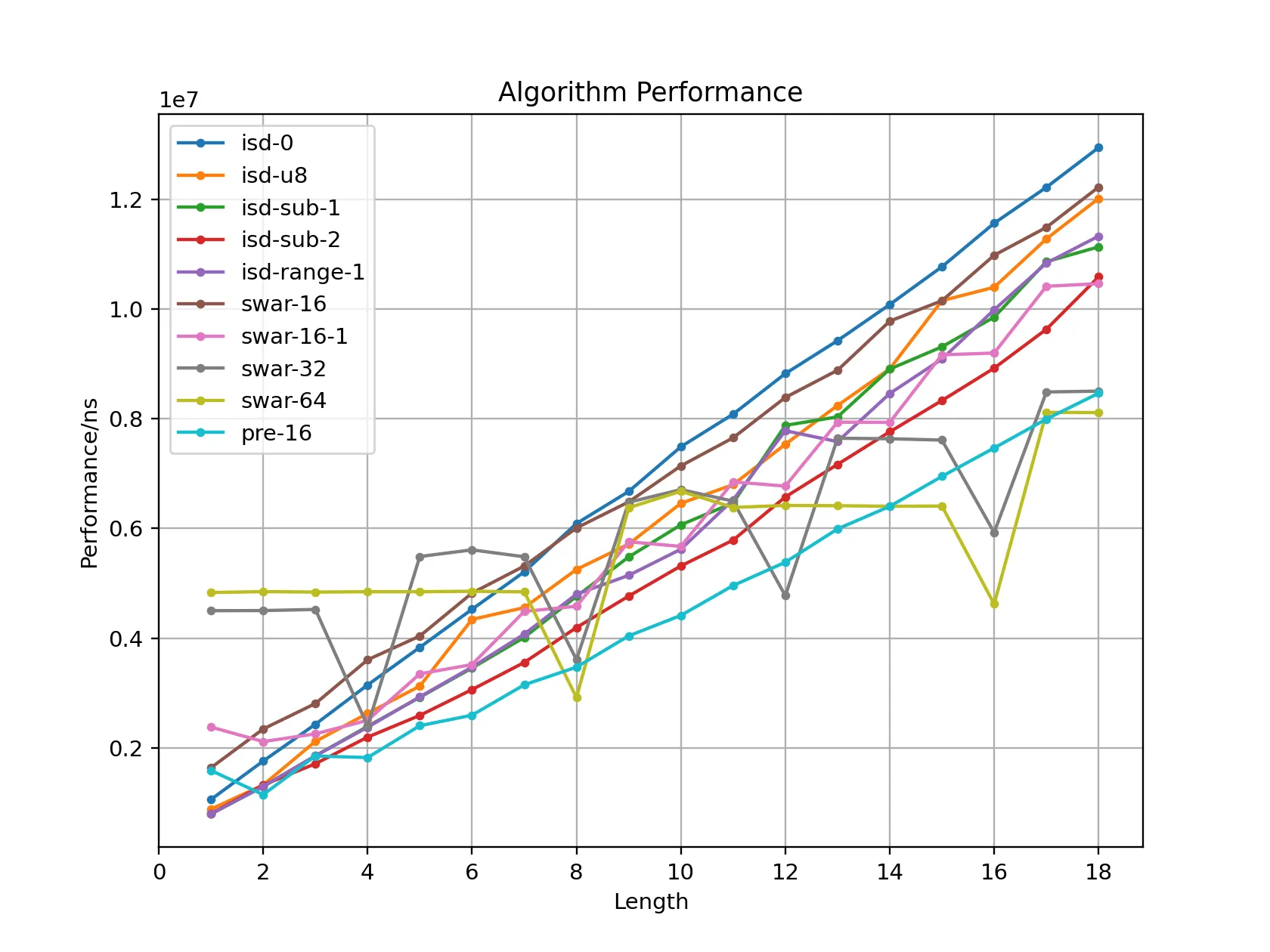
We can draw the following conclusions:
- Using
isd-0as the baseline,sub-2reaches about 122% efficiency, so there is still a noticeable improvement. - The
swarfamily performs very well for long numbers. For example,swar-64reaches 159% efficiency, and even 250% at len = 16. But at len = 1 it is only 21%, because the overhead for short numbers is too large. pre-16has a better constant factor, reaching about 152% efficiency for medium and long numbers.
In short, I choose pre-16 as the final implementation.
Afterword
Code repository: github/bench-int-parse.
One day, while doing routine constant optimization for NTT, I suddenly started doubting input efficiency. I looked up several references, and this post is the result.
Some random ideas I have not had time to think through:
- Maybe
sub-2andpre-16can be hybridized again. - It might be possible to read a
u64at a time and use bit operations to simulate readingu16andu32, which may be faster than reading each time. - It would be worth testing performance with loop unrolling enabled. The compiler may arrange instructions better and obtain lower latency.
References
- Faster Integer Parsing
- Translation: Faster Integer Parsing
- Parsing series of integers with SIMD
- Parsing 8-bit integers quickly